The three agent families at a glance
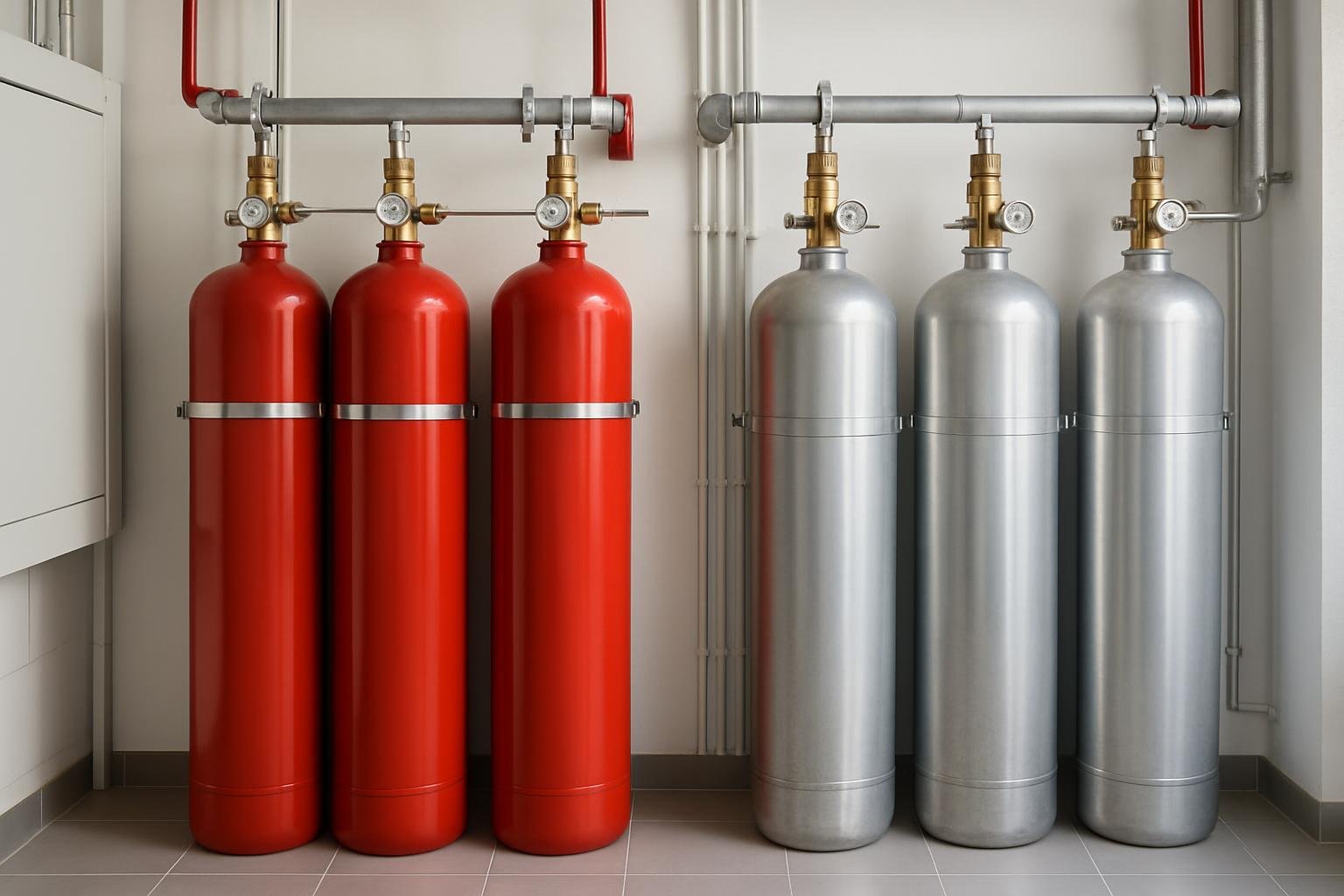
Every agent here is a total-flooding clean agent: it floods an enclosed room to a calculated design concentration, suppresses the fire, then leaves no residue to clean off sensitive electronics. The differences sit in chemistry, environmental impact and how they are stored. Halocarbons (FM-200 and Novec 1230) are stored as a liquefied agent in compact cylinders and extinguish mainly by absorbing heat at low single-digit-percent concentrations. Inert gases are stored as high-pressure gas and extinguish by lowering room oxygen to a level below combustion but still breathable.
- FM-200 (HFC-227ea) — a hydrofluorocarbon halocarbon; smallest footprint, but a high-GWP agent being phased down under the Kigali Amendment.
- Novec 1230 (FK-5-1-12) — a fluoroketone with very low GWP (~1) and a ~5-day atmospheric lifetime; a compact liquid agent with a wide occupied-space safety margin.
- Inert gases (IG-541 / IG-55) — blends of naturally occurring nitrogen, argon (and CO2 in IG-541); zero GWP and ODP, but the largest storage footprint.
Side-by-side comparison table
The table below summarises the key properties. Treat every numeric figure (GWP, atmospheric lifetime, design concentration) as illustrative and edition-dependent — confirm the binding values against the current code and the specific manufacturer's UL/FM listing for your room.
| Property | FM-200 (HFC-227ea) | Novec 1230 (FK-5-1-12) | Inert gases (IG-541 / IG-55) |
|---|---|---|---|
| Chemical family | Hydrofluorocarbon (HFC) halocarbon | Fluoroketone (fluorinated ketone) | Blends of naturally occurring inert gases (N2 / Ar / CO2) |
| Composition | 1,1,1,2,3,3,3-heptafluoropropane (single compound) | C6 fluoroketone, CF3CF2C(=O)CF(CF3)2 (single compound) | IG-541 ~52% N2 / ~40% Ar / ~8% CO2; IG-55 ~50% N2 / ~50% Ar |
| Approx. GWP (100-yr) | High — commonly cited ~3,220 (IPCC AR4; ~3,350 in AR5 — varies by edition) | Very low — ~1 (often cited <1) | 0 (negligible / not applicable) |
| ODP | 0 | 0 | 0 |
| Atmospheric lifetime | Long — roughly 31–42 years (often ~36 yr) | Very short — ~5 days | Negligible (atmospheric constituents) |
| Extinguishing mechanism | Mainly heat absorption / physical cooling | Mainly heat absorption / physical cooling | Oxygen reduction to ~12–12.5% (below combustion, still breathable) |
| Typical design concentration | Low single-digit % (commonly ~7–9% vol, listing/hazard specific) | Low single-digit % (manufacturer/listing specific) | High — approximately 38–50% vol (varies by brand/listing; consult listing) |
| Storage form | Liquefied compressed gas (compact) | Liquefied / super-pressurised liquid agent (compact) | High-pressure gas, typically 200–300 bar |
| Relative storage footprint | Smallest (fewest, most compact cylinders) | Small (similar to FM-200; agent is a liquid) | Largest (many high-pressure cylinders, larger piping) |
| Design standard | NFPA 2001 / ISO 14520 (EN 15004) | NFPA 2001 / ISO 14520 (EN 15004) | NFPA 2001 / ISO 14520 (EN 15004) |
| Occupied-space safety | NOAEL 9.0% / LOAEL 10.5% (cardiac sensitisation); limited exposure times per NFPA 2001 | Wide margin between extinguishing and exposure limits; favourable for occupied spaces | Breathable at design O2 (~12%); limited exposure time per NFPA 2001 |
| Environmental / regulatory status | Being phased DOWN under Kigali (NOT banned); existing systems legal, service agent still available; rising cost/supply risk | Low-GWP; 3M ceased manufacture end-2025; FK-5-1-12 chemistry supplied by other makers; note PFAS status | No GWP/ODP regulatory pressure; favoured for long-term sustainability |
FM-200 is being phased down, not banned
This is the single most misunderstood point in the market, so it is worth stating plainly. FM-200 (HFC-227ea) is not banned in the UAE. It is a high-GWP hydrofluorocarbon being phased down under the Kigali Amendment to the Montreal Protocol (adopted 2016), which commits parties to cut bulk HFC production and consumption by roughly 80–85% over the phase-down schedule (final reduction steps run into the 2040s, and exact dates depend on the country group).
What the phase-down actually means for owners
- Existing systems stay legal. You may continue to own, operate, recharge and service an installed FM-200 system. There is no mandate to rip it out.
- The limit is on bulk supply of new HFC, not on equipment in service. Agent continues to be available to recharge existing systems.
- The real impact is cost and supply risk. As bulk HFC is squeezed, recharge agent tends to get more expensive and less certain over the system's life — a budgeting and lifecycle issue, not an immediate compliance one.
If you operate an existing FM-200 system, see our FM-200 suppression page and book it into a fire maintenance AMC so cylinder weighing and integrity testing stay current.
Novec 1230: low GWP, but watch the supply chain
Novec 1230 was the 3M trade name for FK-5-1-12, a fluoroketone with a GWP of about 1 and an atmospheric lifetime of roughly five days — among the lowest of any chemical clean agent, and zero ODP. It floods at low single-digit-percent concentrations like FM-200, stores compactly as a liquid, and has a wide margin between its extinguishing concentration and its human-exposure limit, which makes it attractive for normally occupied rooms.
Two things to verify before specifying it
- 3M discontinued its own Novec 1230 by end-2025 (last orders around 31 March 2025), as part of its wider PFAS exit. This applies to the 3M brand, not to the FK-5-1-12 chemistry, which other manufacturers (for example Fike and Kidde) continue to supply.
- Substituting a third-party FK-5-1-12 into an existing UL-Listed / FM-Approved system generally needs the original system manufacturer's consent. Do not assume agents are drop-in interchangeable within a listed system.
- FK-5-1-12 is a PFAS. Regulatory treatment of PFAS is evolving and may change the agent's long-term status independently of its GWP — worth tracking for a system you expect to run for decades.
Inert gases: zero GWP, larger footprint
Inert-gas agents under NFPA 2001 include IG-541 (Inergen) — roughly 52% nitrogen, 40% argon and 8% CO2 — and IG-55 (Argonite), about 50% nitrogen and 50% argon. They are composed of naturally occurring atmospheric gases, with GWP and ODP of zero and negligible atmospheric lifetime, so they carry no phase-down or GWP regulatory exposure at all.
The trade-off is physical. Inert gases suppress by lowering room oxygen to about 12–12.5% — below the threshold that sustains most fires, but still breathable for occupants during a managed egress. Achieving that requires a high design concentration (commonly around 38–50% by volume, depending on the agent, hazard and listing) of gas stored at high pressure (typically 200–300 bar). In practice that means significantly more cylinders, larger piping and a bigger cylinder room than the liquefied halocarbons need for the same protected volume. If floor space for the agent store is tight, that footprint is often the deciding constraint.
How the agents actually put out the fire
Understanding the mechanism explains the concentration and footprint differences:
- Halocarbons (FM-200, Novec 1230) work mainly by physical heat absorption — they pull energy out of the flame at low single-digit-percent concentrations, so a small mass of agent protects a large room.
- Inert gases (IG-541, IG-55) work by displacing oxygen down to ~12–12.5%. The fire starves while the atmosphere stays breathable, but a much higher volume of gas is needed, hence the larger store.
Both approaches discharge to a design concentration calculated for the specific enclosure. The room must hold that concentration long enough to fully extinguish and prevent re-ignition, which is why every clean-agent room must pass an enclosure-integrity (room-integrity / door-fan) test. Pair the suppression system with a properly zoned fire alarm system for detection, pre-discharge alarm and the discharge release sequence.
Safety: clean agents are NOT CO2
A dangerous misconception is to treat clean agents like carbon dioxide systems. NFPA 2001 explicitly excludes CO2 (which is covered by the separate NFPA 12 standard) and water.
- NFPA 2001 clean agents are designed for normally occupied spaces. Halocarbon design concentrations are kept below the cardiac-sensitisation NOAEL where possible, with defined maximum exposure times in the NFPA 2001 tables. For HFC-227ea, NFPA 2001 cites a NOAEL of 9.0% and a LOAEL of 10.5% by volume. FK-5-1-12 has a wider margin between extinguishing concentration and exposure limit. Inert gases keep the atmosphere breathable at the design oxygen level.
- CO2 (NFPA 12) is a lethal asphyxiant intended for unoccupied or special-hazard applications — a fundamentally different safety regime.
Egress and integrity still apply to every clean-agent room
Occupied-space rating is not a substitute for life-safety provisions. Regardless of which agent you choose, the installation must include a pre-discharge alarm, time delay, marked egress, and pass an enclosure-integrity test so the agent is actually held at concentration. Support that with emergency exit lighting, and where the enclosure relies on rated separation, with passive fire protection and fire doors that keep the room sealed.
Selection guidance: new vs existing UAE installations
The right agent depends on whether you are servicing an existing system or designing a new one, the size and occupancy of the room, and your tolerance for long-term regulatory and cost risk.
| Scenario | Guidance |
|---|---|
| Existing FM-200 system in service | Legal to keep, operate and service. No mandate to remove. Budget for higher recharge cost and supply risk over time; verify the enclosure still passes its integrity test. |
| New install, space-constrained cylinder room | A halocarbon gives the smallest footprint — favour low-GWP FK-5-1-12 over HFC-227ea for long-term compliance; confirm the FK-5-1-12 supply source and system listing. |
| New install, sustainability / long-term certainty priority | Inert gas (IG-541 / IG-55) carries zero GWP/ODP and no phase-down exposure, or choose FK-5-1-12; trade a larger footprint for inert-gas certainty. |
| Normally occupied space (control / server rooms with staff) | All three are occupied-space rated under NFPA 2001. Keep the design concentration within NOAEL margins, with pre-alarm, time delay and egress. FK-5-1-12 offers a wide safety margin. |
| Any UAE project | Confirm agent, concentration, discharge time and integrity test against the current UAE Fire and Life Safety Code edition, and obtain the relevant Civil Defence authority approval (criteria can vary by emirate). |
Commonly confused points, set straight
| Point | Correct position |
|---|---|
| Is FM-200 'banned'? | No — it is phased DOWN under the Kigali Amendment. Existing systems may be operated, recharged and serviced; the limit is on bulk HFC production/consumption. |
| Is Novec 1230 'discontinued'? | 3M stopped making it (end-2025). The underlying FK-5-1-12 agent is still produced by other manufacturers; third-party FK-5-1-12 in a listed system requires the system maker's consent. |
| Are clean agents the same as CO2? | No. NFPA 2001 clean agents are for normally occupied spaces; CO2 (NFPA 12) is a lethal asphyxiant for unoccupied / special hazards. Egress and integrity provisions still apply to clean-agent rooms. |
| ISO 14520 vs NFPA 2001 | Parallel standards that recognise the same agents and broadly align. EN 15004 is the European implementation of ISO 14520. Confirm which the local AHJ / Civil Defence requires. |
| 'Class C' fire | Conventions differ: NFPA / US uses Class C for energized electrical equipment, while the EN 2 (Europe / ISO) scheme uses Class C for flammable gases and has no dedicated electrical class. UAE practice and AHJ documents often follow the US 'Class C = electrical' usage for switchgear and server rooms — confirm which scheme the specification and Civil Defence apply before relying on the letter. |
Standards, codes and UAE approval
Two parallel design standards govern clean-agent systems: NFPA 2001 (US) and ISO 14520 (international, e.g. ISO 14520-1:2023), with EN 15004 as the European implementation of ISO 14520. They recognise the same agents and broadly align on specs and design concentrations, but they are not identical.
In the UAE, gaseous clean-agent systems must comply with the UAE Fire and Life Safety Code of Practice and be approved by the relevant Civil Defence authority. The Code references international design standards (notably NFPA 2001), but local authorities set the binding approval criteria and these can differ by emirate and code edition. Whether a project must follow NFPA 2001, ISO 14520 / EN 15004, or may use either is a question for the authority having jurisdiction — confirm it before design.
Practical do / don't
- Do use the manufacturer's UL/FM-listed design values and NFPA 2001 / ISO 14520 calculations for the actual room — not the illustrative figures in this guide.
- Do commission an enclosure-integrity (door-fan) test and confirm the minimum agent hold time.
- Do clarify the fire-class scheme (NFPA vs EN 2) in the specification for any electrical or server-room hazard.
- Don't assume one service or retest interval applies — NFPA 2001 and ISO 14520 / EN differ, and Civil Defence may require its own.
- Don't swap a third-party FK-5-1-12 into a listed system without the original manufacturer's consent.
For end-to-end delivery in the Emirates, see our fire suppression systems overview, fire system installation, and Civil Defence approvals services across Dubai, Abu Dhabi, Sharjah and Ajman.
This page is general guidance for the UAE and is not a design document. GWP figures, atmospheric lifetimes, design concentrations, NOAEL/LOAEL values, service intervals and integrity-test criteria all vary by source edition (IPCC AR4/AR5/AR6, NFPA / ISO edition) and by emirate. Always confirm the exact figures and intervals with the Adiga Fire team and your relevant Civil Defence authority, and use the manufacturer's listed values and NFPA 2001 / ISO 14520 calculations for the specific room before any design or procurement decision.
Frequently asked questions
Is FM-200 banned in the UAE?
No. FM-200 (HFC-227ea) is being phased down, not banned, under the Kigali Amendment to the Montreal Protocol. Existing systems remain legal to own, operate, recharge and service, and agent is still available for recharging. The Kigali restriction targets bulk HFC production and consumption (a roughly 80-85% reduction over the phase-down schedule), so the practical effect over a system's life is rising agent cost and supply uncertainty rather than forced removal. Confirm the current position with your Civil Defence authority.
Was Novec 1230 discontinued, and can I still get it?
3M discontinued its own Novec 1230 by the end of 2025 (last orders around 31 March 2025) as part of its wider PFAS exit. That applies to the 3M brand only — the underlying chemistry, FK-5-1-12, continues to be supplied by other manufacturers such as Fike and Kidde. If you want to put a third-party FK-5-1-12 into an existing UL-Listed or FM-Approved system, you generally need the original system manufacturer's consent first, as agents are not automatically interchangeable within a listed system.
Which agent has the smallest storage footprint?
The halocarbons — FM-200 and Novec 1230 — have the smallest footprint because they are stored as a liquefied agent in compact cylinders and flood at low single-digit-percent concentrations. Inert gases (IG-541 / IG-55) need the largest store: they are kept as high-pressure gas (typically 200-300 bar) and flood at roughly 38-50% by volume, so they require more cylinders and larger piping for the same protected volume. If the cylinder room is tight, footprint is often the deciding factor.
Are clean agents safe for rooms with people in them?
All three families are rated for normally occupied spaces under NFPA 2001 when designed correctly — this is a key difference from CO2 (NFPA 12), which is a lethal asphyxiant for unoccupied or special-hazard use. Halocarbon design concentrations are kept below the cardiac-sensitisation NOAEL (for HFC-227ea, a NOAEL of 9.0% and LOAEL of 10.5%), inert gases keep the atmosphere breathable at the design oxygen level, and FK-5-1-12 has a wide safety margin. Regardless of agent, the room must still have a pre-discharge alarm, time delay, marked egress and pass an enclosure-integrity test.
For a new server room in the UAE, should I choose Novec 1230 or inert gas?
Both are good choices; the trade-off is footprint versus certainty. FK-5-1-12 (Novec 1230 chemistry) gives a compact store and a wide occupied-space safety margin, ideal where cylinder-room space is limited — but verify the supply source and the system listing. Inert gas (IG-541 / IG-55) carries zero GWP/ODP and no phase-down exposure, which suits a sustainability or long-term-certainty priority, at the cost of a larger store and more piping. For any UAE project, confirm the agent, concentration, discharge time and integrity test against the current UAE Fire and Life Safety Code and obtain Civil Defence approval, as criteria can vary by emirate.
Sources & references
- Chemours — FM-200 Fire Suppressant: Montreal Protocol / Kigali HFC Amendment
- UNEP OzonAction — Kigali Fact Sheet No. 5: HFC Baselines and Phase-down Timetable
- Kord Fire — The FM-200 Phase-Out Explained & Your Fire Suppression Impacts
- Wikipedia — 1,1,1,2,3,3,3-Heptafluoropropane (HFC-227ea)
- 3M Novec 1230 Fire Protection Fluid — Technical Data (FK-5-1-12)
- Fike — 3M Novec 1230 Discontinued: What Now? (FK-5-1-12 alternatives)
- Firetrace — Novec 1230 Patent Expired / What is FK-5-1-12 (generic clean agent)
- Consulting-Specifying Engineer — Selecting the correct clean agent suppression system
- US Made Supply — NFPA 2001 Clean Agent Systems: FM-200, Novec 1230, Inergen
- Lifeco — HFC227ea vs FK5112 Fire Suppression Systems in UAE
- Lifeco — NFPA vs UAE Fire Code for Suppression Systems
- VortexFire — Amendments to the UAE Fire and Life Safety Code of Practice 2018
- Building Doctor (UAE) — NFPA 2001 and ISO 14520: The Firefighting Aces
- ISO 14520-1:2023 — Gaseous fire-extinguishing systems
- Wikipedia — Fire class (Class C: NFPA vs EN 2)
- Wikipedia — Gaseous fire suppression
- MeyerFire — Why Different IG-541 Concentrations by Brand?
- NAFFCO — HFC-227ea Clean Extinguishing Agent Description